

Hi everyone,
I am excited to update you on Grab’s business, a position I acquired in October 2024. So much has been going on this year that may impact the business's long-term trajectory, such as the fuel crisis and FX headwinds, and the rise of EV fleets. I’ll discuss that elephant in the room - Autonomous driving and AI impacts.
But first, I’ll dig into the core flywheel customers and drivers, groceries expansion, advertising, and that promising fintech segment.
For a solid background of the business and industry, read my deep dive here and all previous updates here.
Disclaimer: As a reader of Sleep Well Investments, you agree to our disclaimer. Full details here.
If you are new to SWI, check out our FAQ and Owner Manual.
1. Core business: more users, more engagement.
The most important metric for a marketplace like Grab is the number of its transacting users and drivers. In the quarter, it delivered.
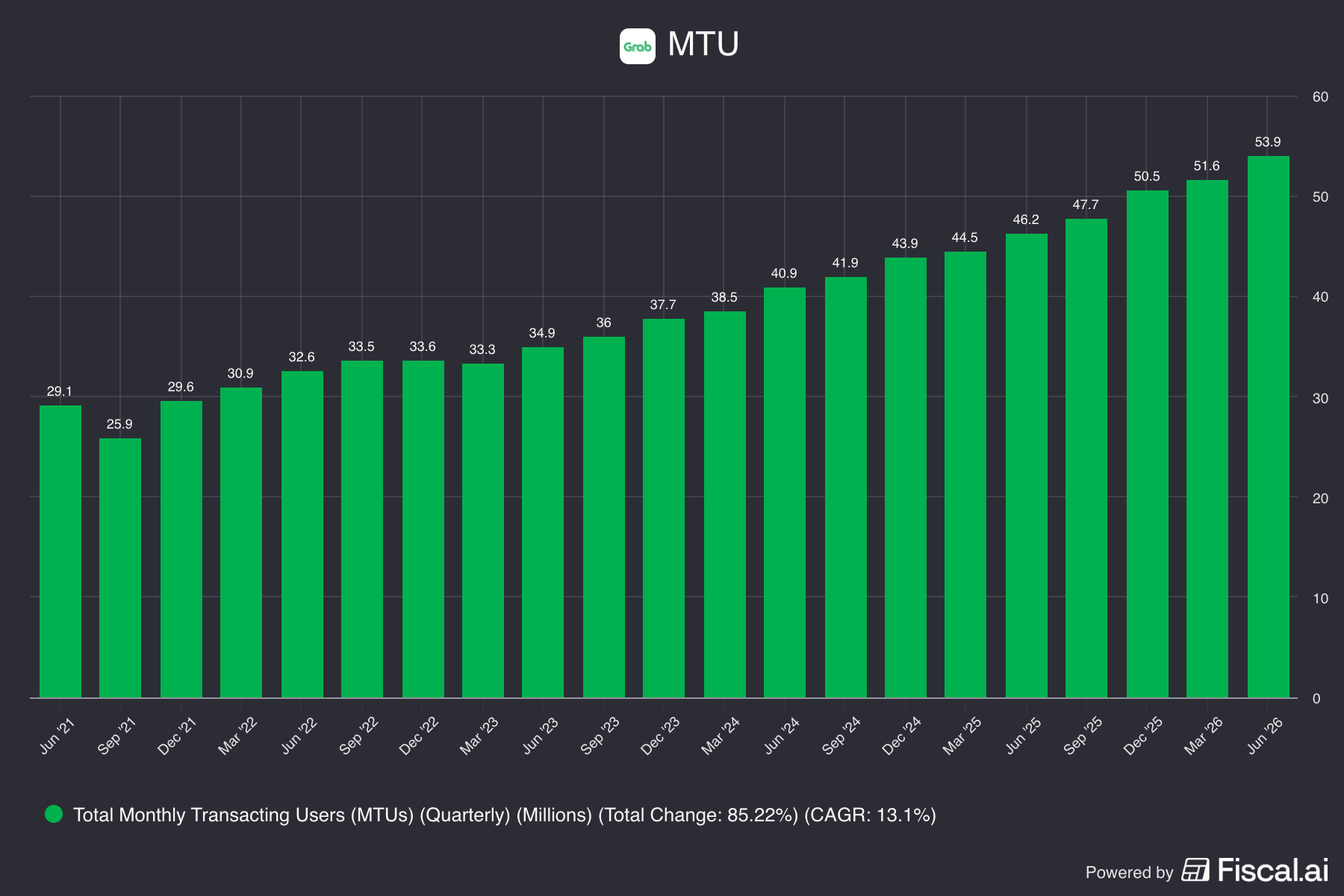
54M MTU, 16.7% YoY growth driven by a 19% increase in monthly active drivers.
Grab ended the quarter with 54 million monthly transactive users, growing 16.7% YoY and higher than the last 5-year compounded annual growth rate of 13%. There is a lot of room to keep growing, considering Uber also reported “adding more first-time users in the last twelve months than in any period in the last five years".
Grab doesn’t disclose how many drivers, but in Q1, a study found Grab had ~ 6 million partners (drivers + merchants); this number grew 19% in Q2. Very healthy supply and demand growth.
Also healthy is that daily transacting users grew faster than monthly transacting users, indicating higher engagement in the period. Grab highlighted that groceries (GrabMart) grew 42% YoY, 1.7 times faster than Food, and is still only 14% of Food’s user base; we’ll go deep on the revenue contribution and the likely significant size of this vertical to Delivery later, but the key takeaway now is that Deliveries have plenty of room to grow.
At the core of Grab, the flywheel is working nicely.
More users, more partners (drivers, merchants), and more engagement (more products).
2. Group financials and segments
The flywheel turns into growing financials
Group
At the group level, revenue grew 22%, GMV grew 21%, and Adj. EBITDA reached $168M, growing 54% YoY.
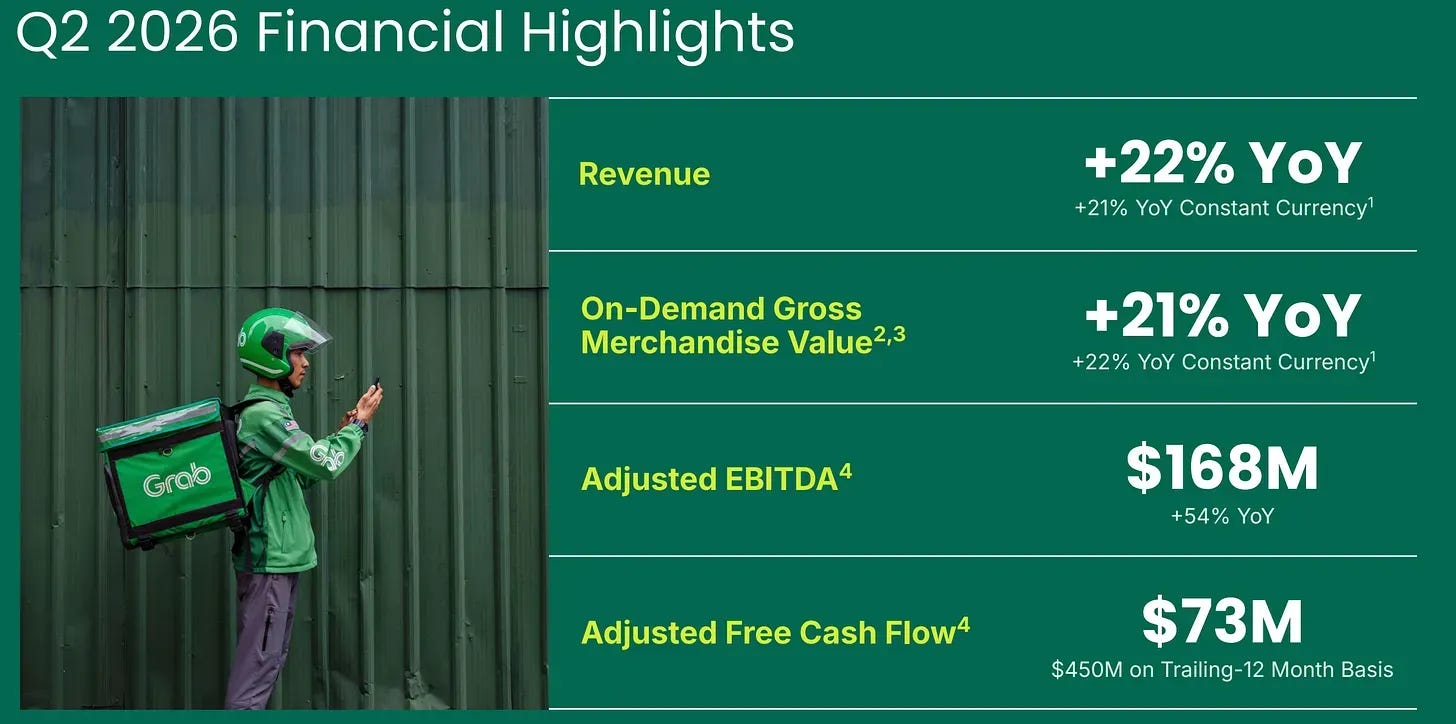
It’s great to see steady and resilient growth despite the fuel crisis (2% of Mobility revenue impacted) and the recently announced commission cap. This is the 18th straight quarter of EBITDA growth.
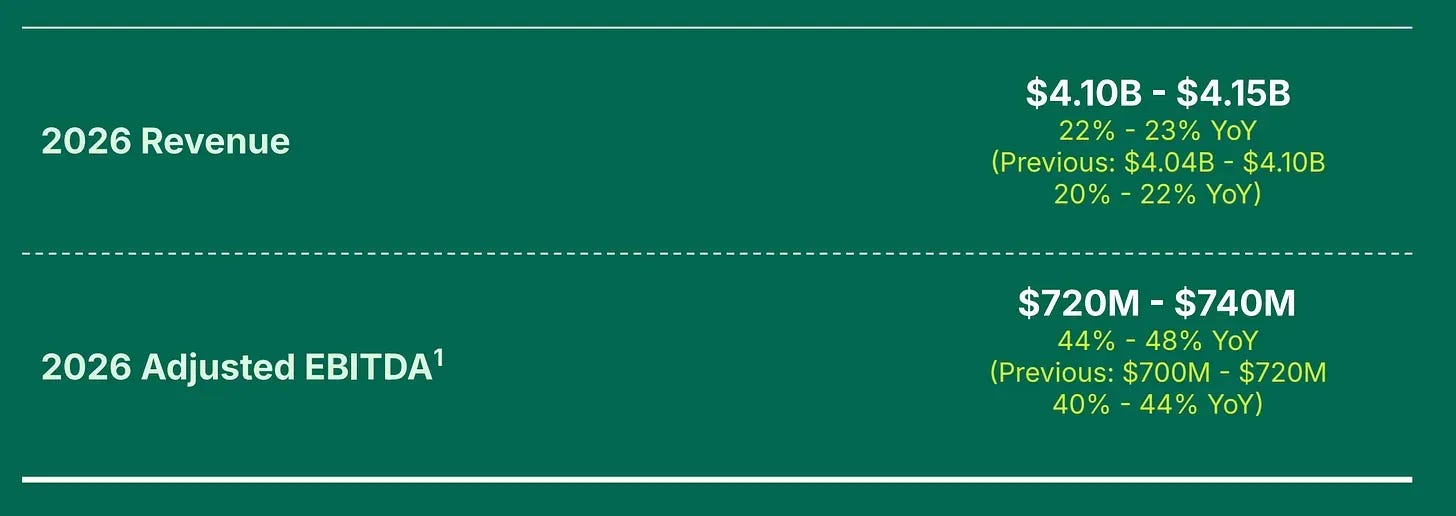
The management sees $4.125B in revenue and $730M in Adj. EBITDA for the year. There is plenty of growth left, so I believe the business is priced very reasonably for a $10B EV (15B market cap) today.
Ok, let’s go into a little more detail.
Mobility: 8-9%Adj. EBITDA margin longterm
Mobility GMV grew 18%, transactions grew 28%, but revenue only grew by 12%.
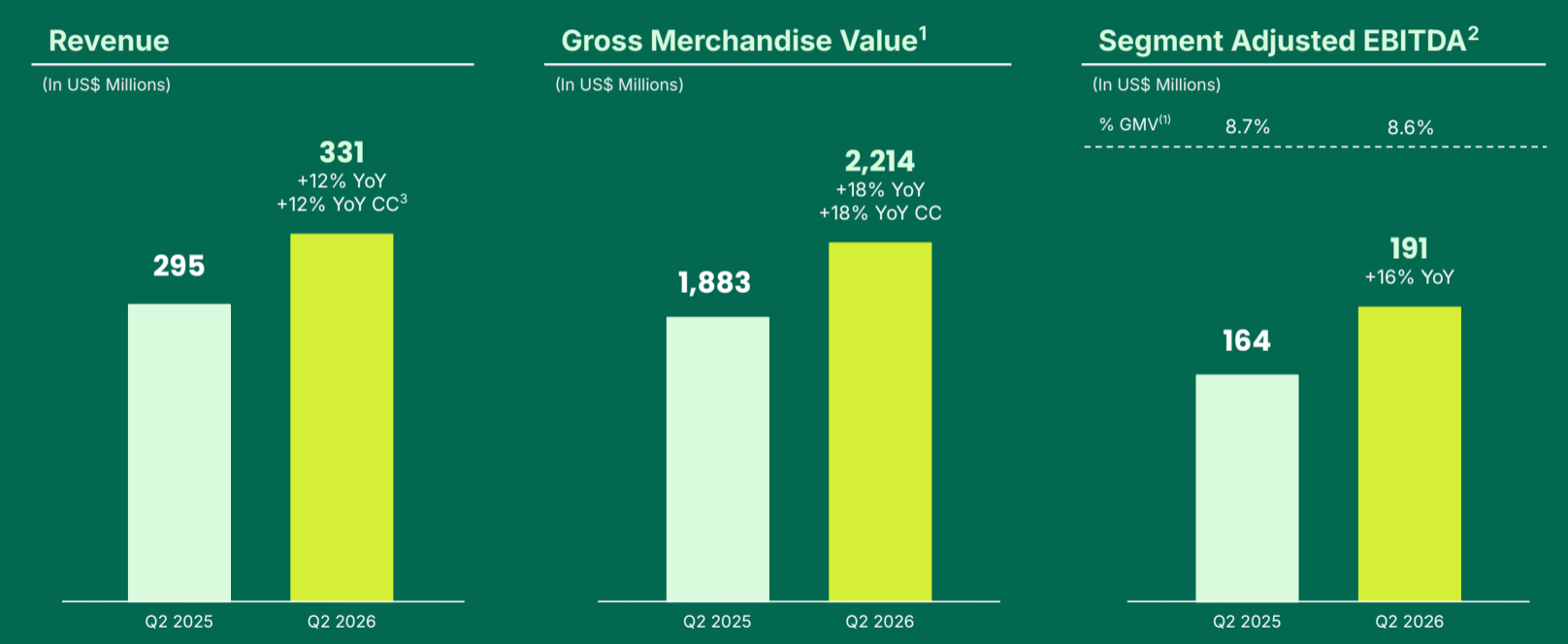
Management explained the lagging revenue growth was due to the net-off from the savers program (cheaper fares) and the targeted incentives to drivers to support the fuel surge.
The goal is to make Grab a sustainable workplace for drivers (more earnings - 4%YoY growth, and less impacted by the fuel surge - $7M targeted support) and an affordable place for customers at the same time. That meant revenue grew more slowly due to more discounts to passengers and more incentives to drivers. We also see that reflected in rising incentives, but it’s something I expect to decrease as the marketplace matures.
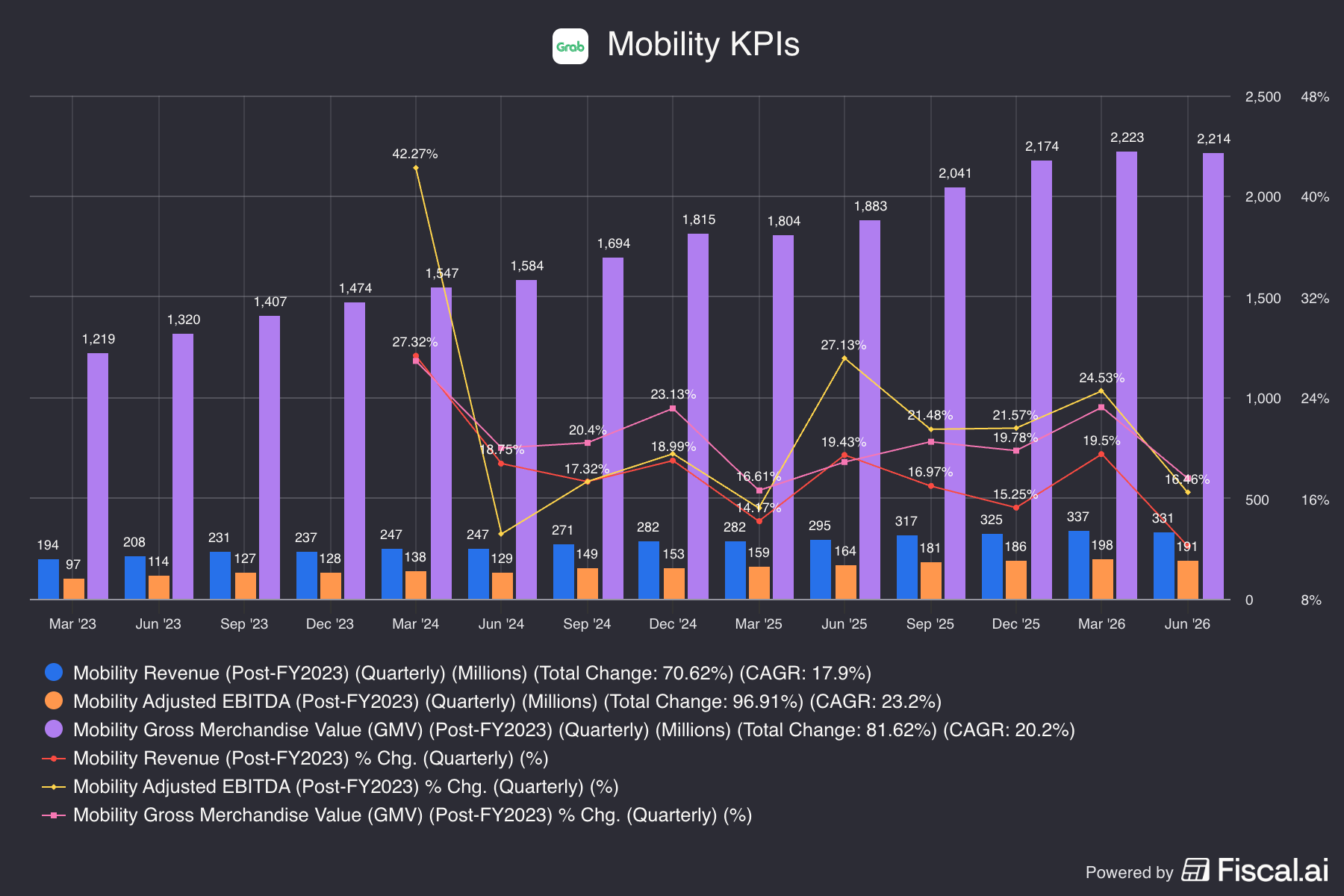
Despite the above, mobility margins this quarter were still at 8.6%, within the 8.5%-9% guidance range. Going forward, with the rollout of EVs, fuel costs will have less impact.
EVs actually have lower costs once the initial investment is made in the vehicle. This quarter, for example, we announced nine new fleet partnerships in Thailand. We've announced a new partnership with Wuling in Indonesia, and we've expanded charging access through the app for drivers in the Philippines. In nearly every market, we have examples of how we're becoming a positive catalyst for the introduction of cleaner vehicles into Southeast Asia.
Now to the key discussion,
Autonomous driving (AV)
AV is a structural risk to Grab; we can already see what is happening with Uber. The many partnerships with OEMs (Zoox - Amazon, Rivian or Lucid) in the US don’t guarantee that Uber will be the aggregation app for AV. It makes sense for the industry, but Waymo and Tesla could go alone and own the whole stack (physical and app). Why wouldn’t they? They have even better distribution than Uber, and they also own the supply of cars and technologies around it. They can also just acquire Lyft if they needed something like Uber.
Looking at Grab, the risk of disruption is less immediate.
First, what Grab has is time. The Southeast Asian region is highly fragmented (8 distinct government policies for AV), chaotic roads, low cost per ride, and low-wage drivers that make it less cost-effective for AV to compete. Most importantly, what is less discussed is…
The next section is for premium members; I discuss the idiosyncrasy of Grab, mapping capabilities, hybrid approach to AV, preparedness for AV. Then I also discuss the growing influence of Groceries and GrabFin. Subscribe for the real details.
