

Meli and Sea Limited are 20%+ positions of my PA and the Sleep Well Portfolio. No shares have been sold since I first bought both in 2020. This is an analysis from an owner's point of view.
For a solid background of the business and industry, read all previous updates here. The tracker spreadsheet is reserved for annual members only [Link].
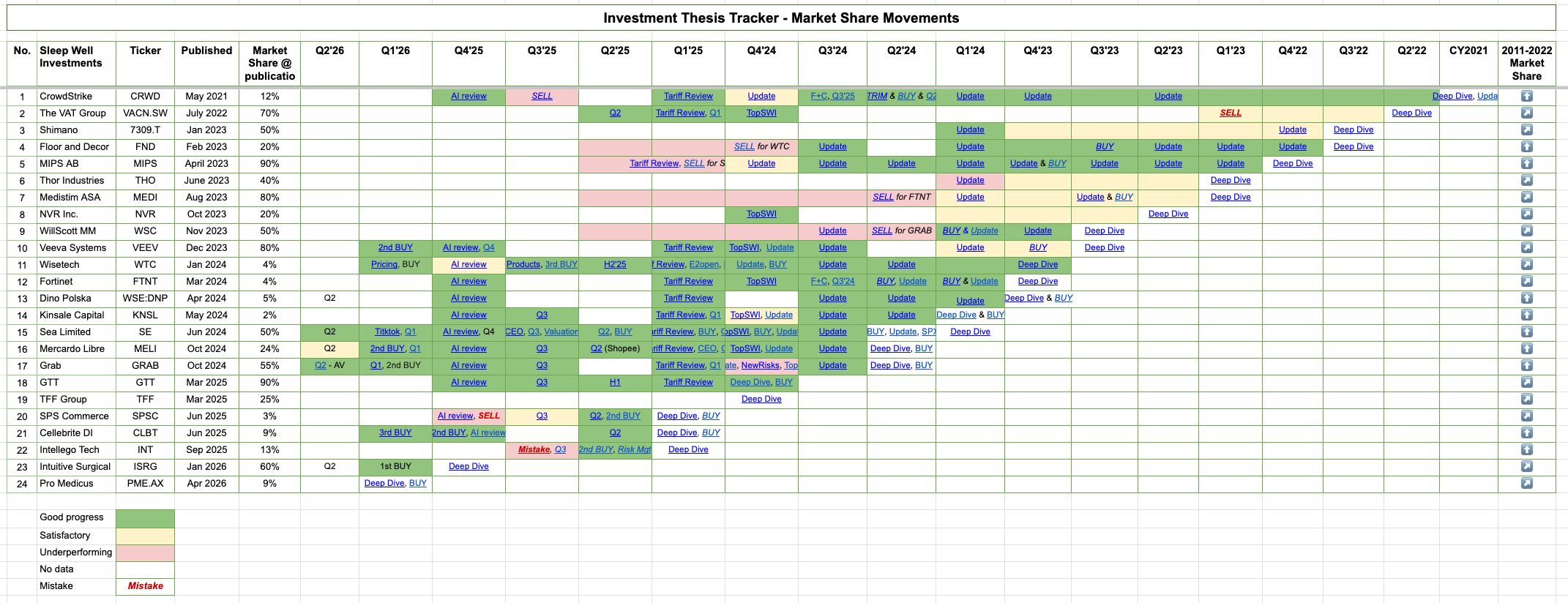
The Sleep Well Portfolio consists of time-tested, market-leading companies. We screen them with a rigorous checklist and regularly track their theses to determine when to buy. So far, we have made one mistake, but are happy with the current 13 holdings. All about us here.
I don’t want you to miss out on the portfolio's fast recovery, so here is a 30% discount for you to hop on the train before it takes off.
Before I review Q2’26 results. Let me be clear about my point of view.
I believe Meli is the best technology business in Latin America. It is an incredibly customer-obsessed, adaptable, and high-growth business that has become the commerce infrastructure of the region; therefore, it is almost impossible to replicate.

The fragmented economies and less-penetrated ecoms and fintech in Latin America mean all parts of Meli above have 5-10 years of high growth ahead, yet they are high barriers to entry to new competition.
If I have to rank, Mercado Pago remains the biggest and clearest opportunity, then Advertising. Meanwhile, Envios (logistics) and Libre (marketplace) are the sticky mousetrap that acquire and retain customers.
I will focus on analyzing Pago today as it has become a ‘durable growth’ lever, but the market is questioning its risk management as it expands too rapidly to customers and merchant credit, away from its original setup, which was to process payments between merchants and customers, online and offline.
Ambition - largest digital bank
Meli’s ambition is to be the largest digital bank in the region.
The roadmap to get there is what Meli calls principalities: it wants to be the primary banking partner with users, serving all of their daily financial needs.
That’s payments, transfers, lending, savings, investments, and insurance.
How these products evolve is driven by its customer feedback measured by the annual NPS survey. That's the Net Promoter Score, showing how satisfied users are with Pago’s service.
In Q2, 70M active users said they were highly satisfied with the service; Meli scores an NPS (net promoter score) of 77, the highest in the industry in Brazil, Mexico, and Argentina. The feedback drives Pago’s roadmap and user experience.
But the conviction to expand Pago so rapidly comes from Meli’s scale, something we know as an ‘ecosystem’.
Together with the marketplace, Meli has 150M active users. A distribution advantage that allows Pago to expand at near zero acquisition costs. Then, a 26-year advantage of historical user data that are high-frequency, real-time, and granular. That’s the underwriting advantage that no one has in the region. I want to key on this a bit more before we move on.
The data for an ecosystemic user is full access to individual navigation patterns and transactional data down to SKU levels.
Meli knows not just how much customers are spending on each category each month, but also if they are buying running shoes, vitamins, and which reviews they are researching.
The longitudinal data shows who is more creditworthy and what levers (credits, installments, cash back) allow the individual to make a purchase.
All this data allows LLMs (AI) to excel even more than other banks, combining transactional, purchase intent, and industry-available data.
Importantly, in challenging or black swan events, Pago can assess which borrowers are most likely to pay and which merchants are likely to recover in challenging times. So when we think about the credit business, they are not giving out credit cards to users who need them; they are giving out the product to customers who shop and interact on Meli and find cashbacks, installments, or other features valuable. Pago can capitalize on this extra information.
Lastly, I can’t emphasize it enough: to achieve the ambition, Meli needs to think and invest long-term.
That’s what we have been seeing over the past year with results that look just like Q2. Strong top-line growth but lower profit and free cash flow.
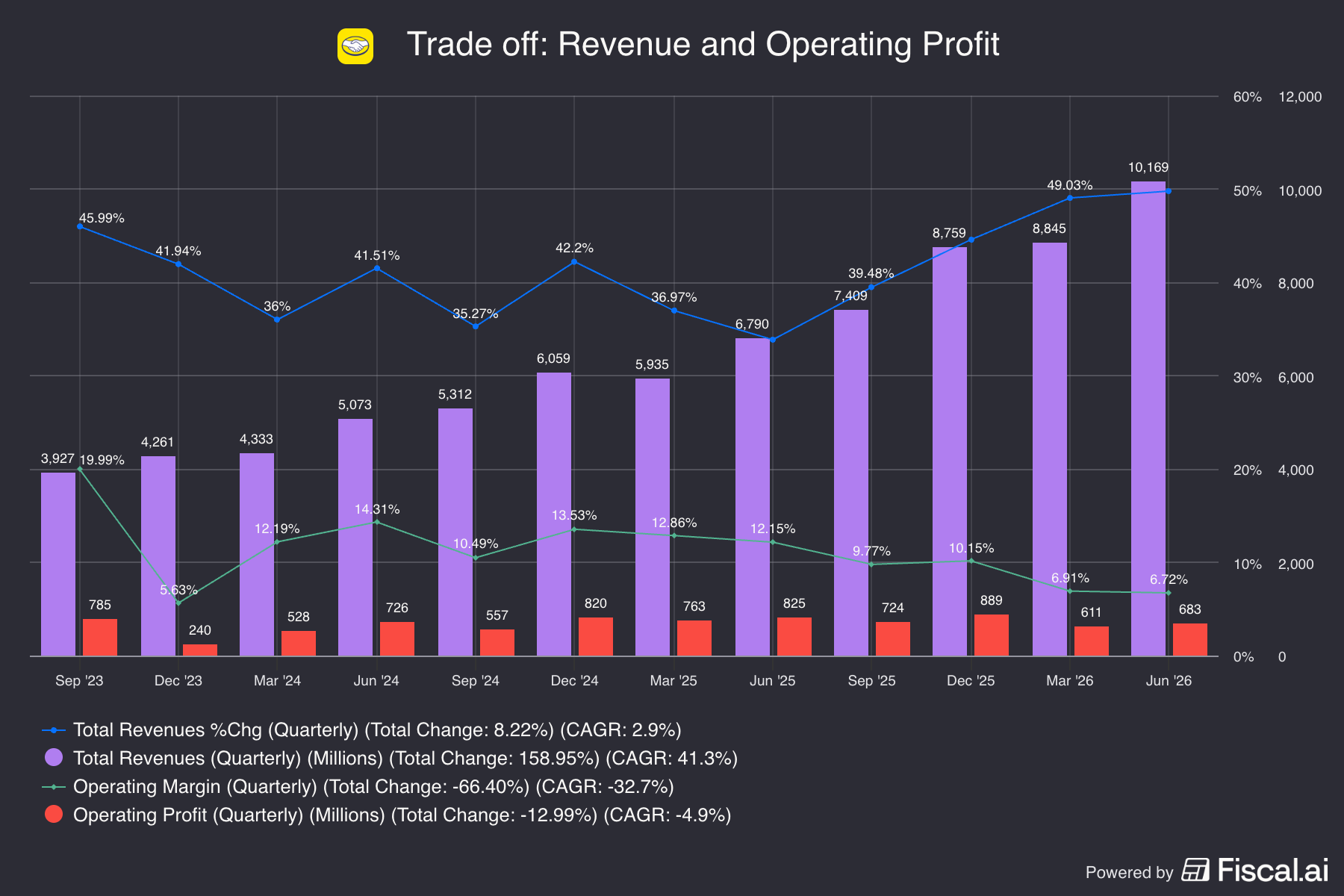
Q2 results - 30th consecutive quarter of revenue growth above 30%
Net revenue and financial income grew 50% YoY, surpassing the $10 billion mark for the first time, the fastest in four years and also the 30th consecutive quarter of growth above 30%. But profitability compressed: operating margin narrowed 550bps to 6.7%, continuing the slide from Q4’24. Management cited continued spend on free shipping and credit cards.
The market didn't love it — shares fell the next few days (only to recover as Sea Limited reported a recovery of Shopee’s margin), reflecting investor caution about margin sustainability given the pace of investment, even as underlying business momentum is acknowledged.
Here are my good and bads from the quarter.
Good - deepen engagement across segments
Commerce - saw deeper engagement, users purchasing more across categories, since the drastic investment in free shipping 4 quarters ago. Unique active buyers rose 26% YoY to 90M, and items per buyer increased 14% YoY. The trend seems durable.
Fintech also saw deeper engagement as users parked more of their money in Pago. Assets under management grew 68% YoY to $23 billion. The credit portfolio reached $16.4 billion in Q2, growing 75% YoY. Total Payment Volume exceeded $100 billion for the first time. Monthly active users rose 30% YoY to 88M, with even faster growth in Brazil and Mexico.
Both segments did well, in my view, but active users who use both products- Meli calls them ecosystemic users- were even more engaged.
Ecosystemic users were the most engaged group by far, making them the company’s most valuable segment. In details:
an ecosystemic user has 70% more GMV on the marketplace and 90% more TPV, double the assets under management. Very much engaged, and that results in better profitability. We also mentioned that the rate of growth of those type of users is the highest of any kind of users.
I think it’s growing 37% year-on-year. We don’t disclose the actual share of users. We just want to make sure that those are important users to us, growing very fast.
Advertising: Revenue grew 73% YoY in USD, powered by greater seller engagement with AI tools and growth broadening beyond Self-Service as momentum strengthened in the cross-border trade (CBT) and Top Brands channels.
Cross-border GMV is growing approximately 60% year-over-year, with triple-digit growth in Brazil, Argentina, and other markets, and above-average growth in Mexico, the largest CBT market by far.
AI: Mercado Libre completed the rollout of its AI-powered marketplace search architecture across its five largest sites, with higher conversion and click-through rates more than offsetting the cost of third-party LLMs.
AI is definitely contributing to cost efficiency.
AI Customer service shrunk to 7,000 reps, from 10,000 four years ago, even though the business grew by 3x in that period. 90% of the interactions are done without a human participating in the issue.
2026 is probably the first year in many years in which Meli was not growing the engineering team. They have 20,000 developers that are using AI. A year ago, they were coding with help from AI. Today, human-written code is the exception.
A few optimistic quotes from the management:
Product development scaled from 8.4% of revenues to 7.2% of revenues year-over-year, even though it has this incremental cost of AI within it.
We are convinced that the 27 years of proprietary data that we have accumulated across commerce, payments, credit, and logistics position us in a good place in order to capture the opportunity that AI is bringing.
Everything to me was good; now the bad, or what I will be monitoring.
Bad - we need to monitor
Margin compressed by almost half to 6.7% compared to a year ago.
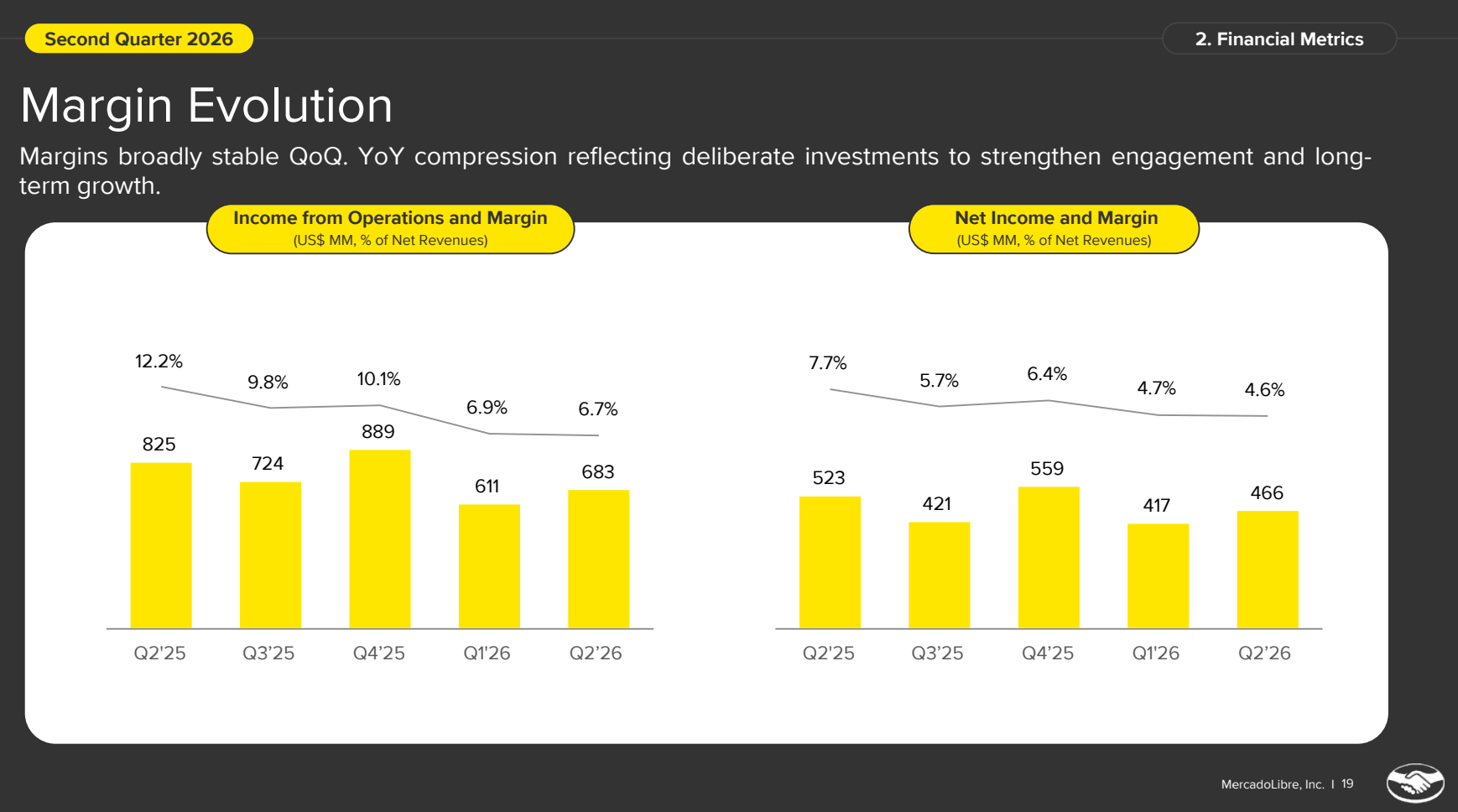
Driven by higher expenditure and investments in free shipping (4.7% operating margin impact) and building the credit portfolio (2.4% margin impact).
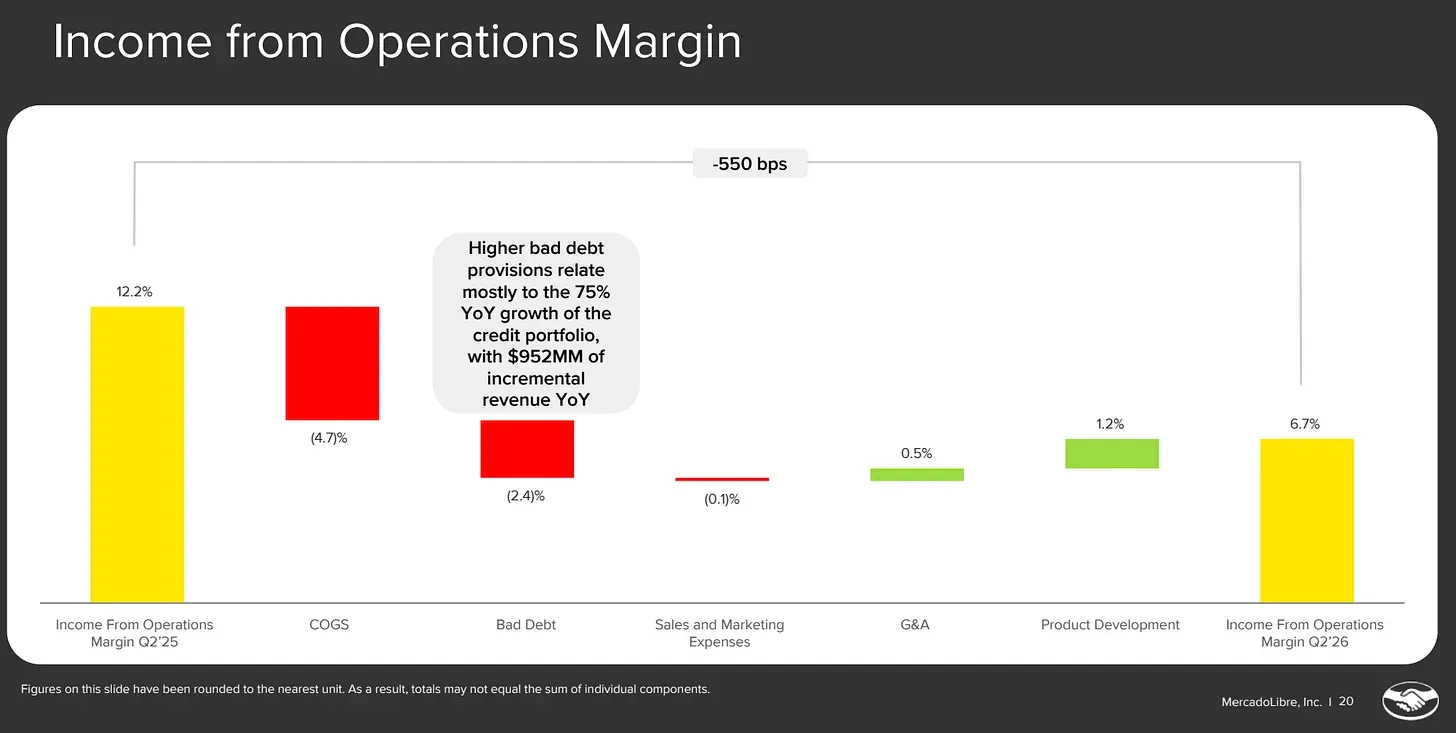
Behind the margin compression are actually two moving parts.
Expansion of the loan book and a shift toward credit cards.
Mixed picture of the loan quality.
Those two drove higher bad-debt provisions. Let’s look at both in detail.