

Enjoy this FREE review of Sea Limited recent reversal! And at the end of the writeup I have a special gift for you.
The Sleep Well Portfolio consists of time-tested, market-leading companies. We screen them with a rigorous checklist and regularly track their theses to determine when to buy. So far, we have made one mistake, but are happy with the current 13 holdings. All about us here.
Shares are now up 70% from 2026 lows, and all it took was a stabilizing Adj.EBITDA margin rate of 0.7% from 0.6% in Q1’26 and Q4’25. The increase in Shopee's take rate was impressive given all the talk about competition. But what’s clear to me is that Shopee is self-sustainable and can turn that profitability tap at will, putting Garena in the back seat, and the focus on Monee, just like Mercado Pago of Meli, is all about their exposure to risk. We’ll focus on Shopee in this write-up.
Below, we see that Shopee has been Adj. EBITDA positive since Q3’24, but a deliberate deceleration in Q3 and Q4 last year threw Mr. Market's confidence in Shopee’s future into doubt. The stock fell from $200/share to $77/share.
We added twice during this period. Sea is now over 55% of my PA.
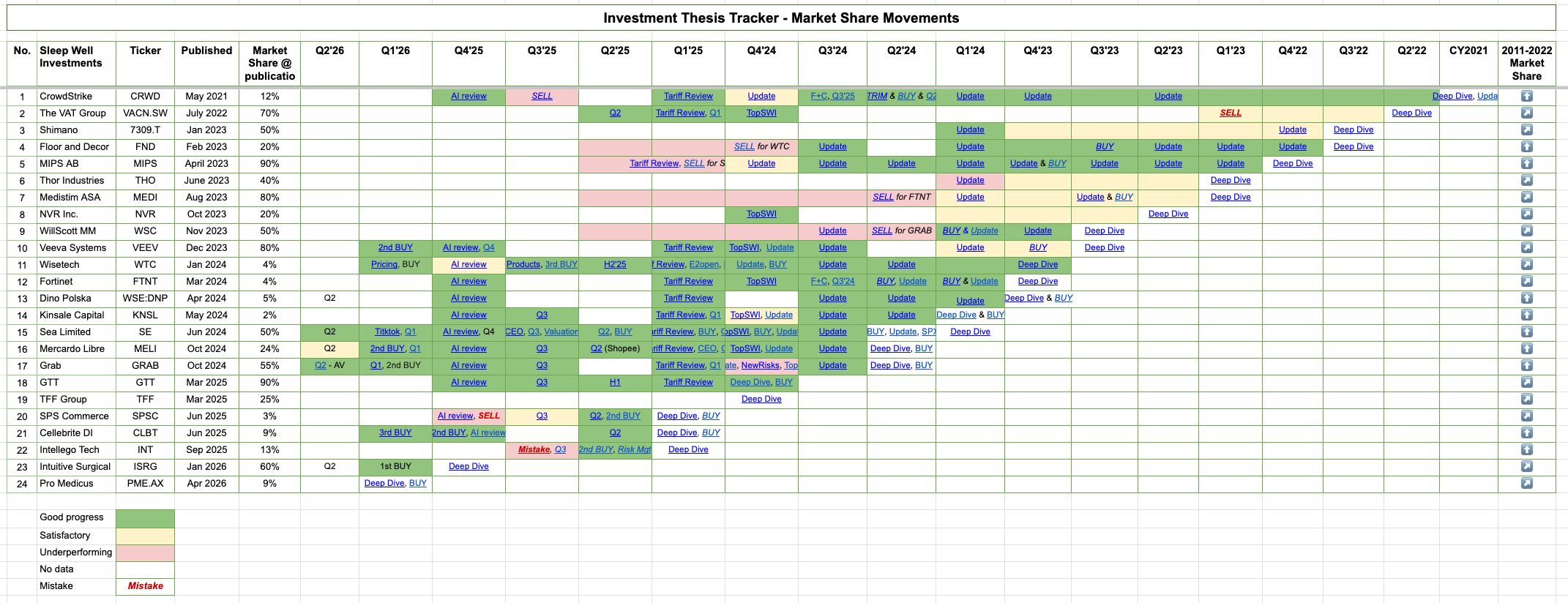
Read all Sea Limited reviews here. The tracker spreadsheet is reserved for annual members only [Link].
Q2’26 shows the first glimpse of a reversal in Adj. EBITDA. It was only growing by 0.1 percentage point to a 0.7% margin in Q2’26, and that was enough for the market to ‘value’ the business at $131/share. Management already spelled out that Q3 and Q4 will be even better!
With this solid momentum we are optimistic that Shopee will achieve the milestone of $1 billion in adjusted EBITDA for the full year. - Forest Li, Q2’26 cc.
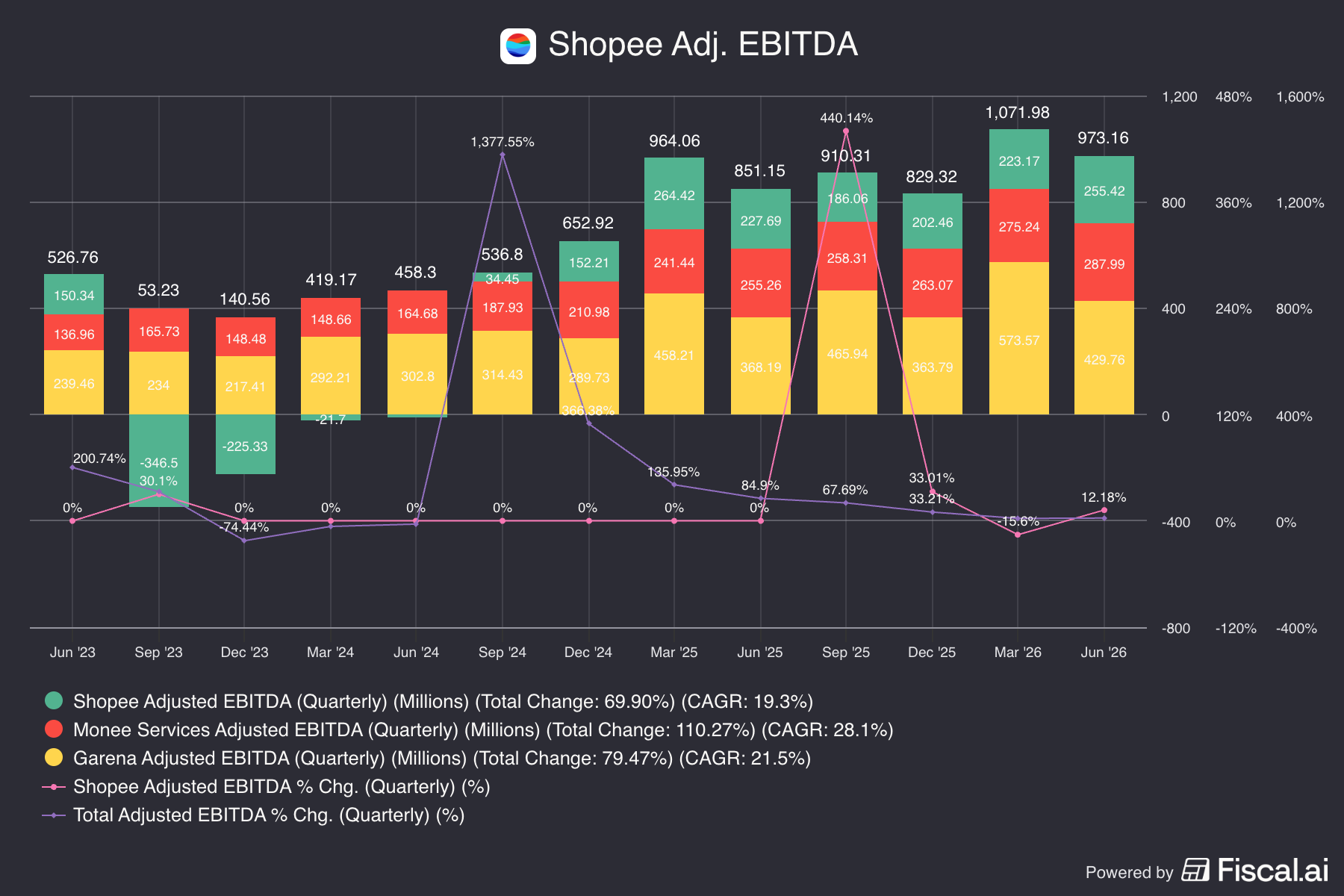
Q1 and Q2 were $478M, meaning Q3 and Q4 will be at least $522M. And compared to H2 of 2025, which was $388M, implying 35% growth YoY.
I think the market will like it.
Now let’s skim through the headlines, and then I’ll focus on the key takeaway in each segment.
Q2’26 Group financials
Revenue grew 48%YoY to $7.8B,
Gross profit grew the same to $3.6B
Adj EBITDA grew 11% to $917M
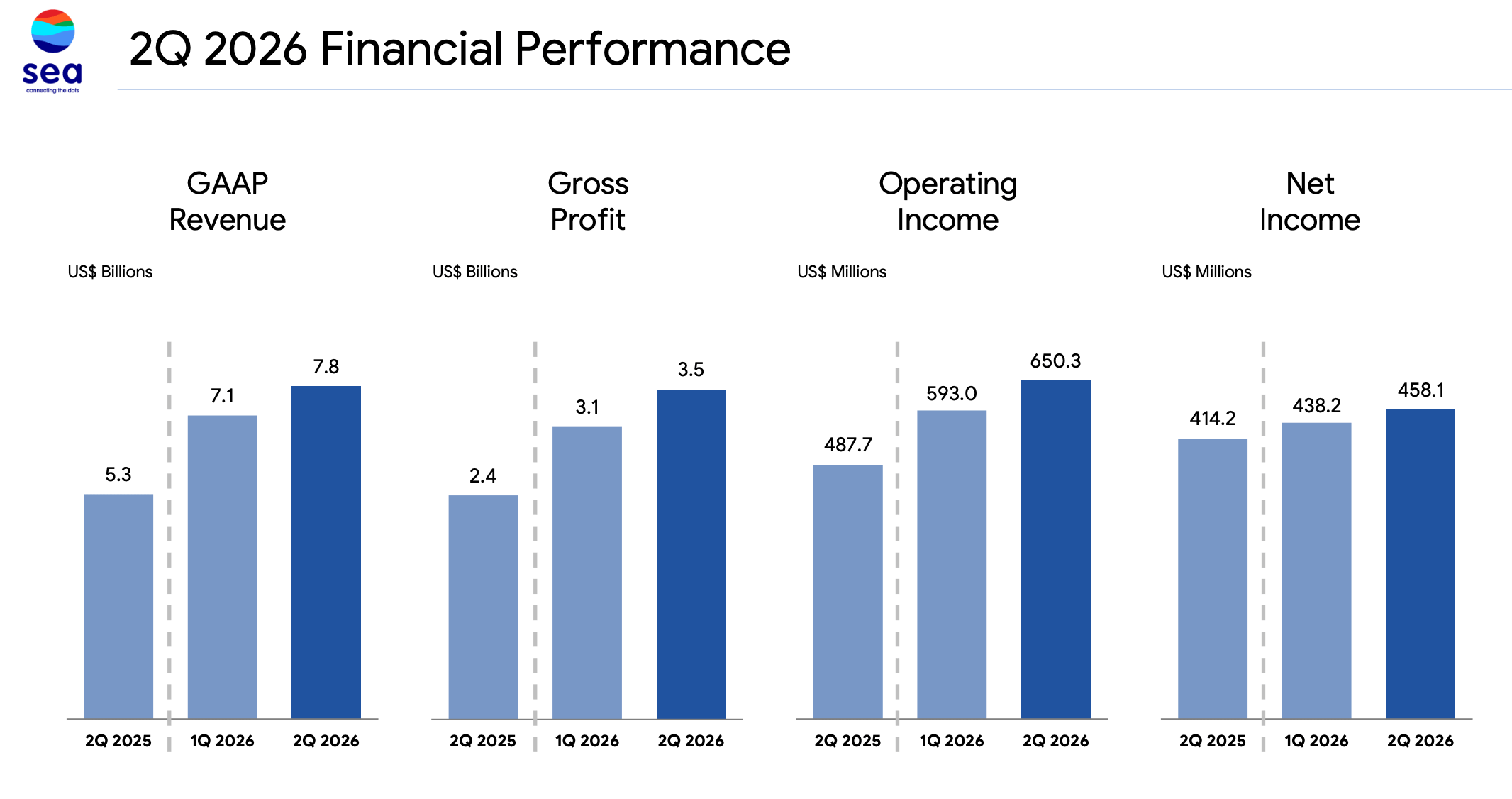
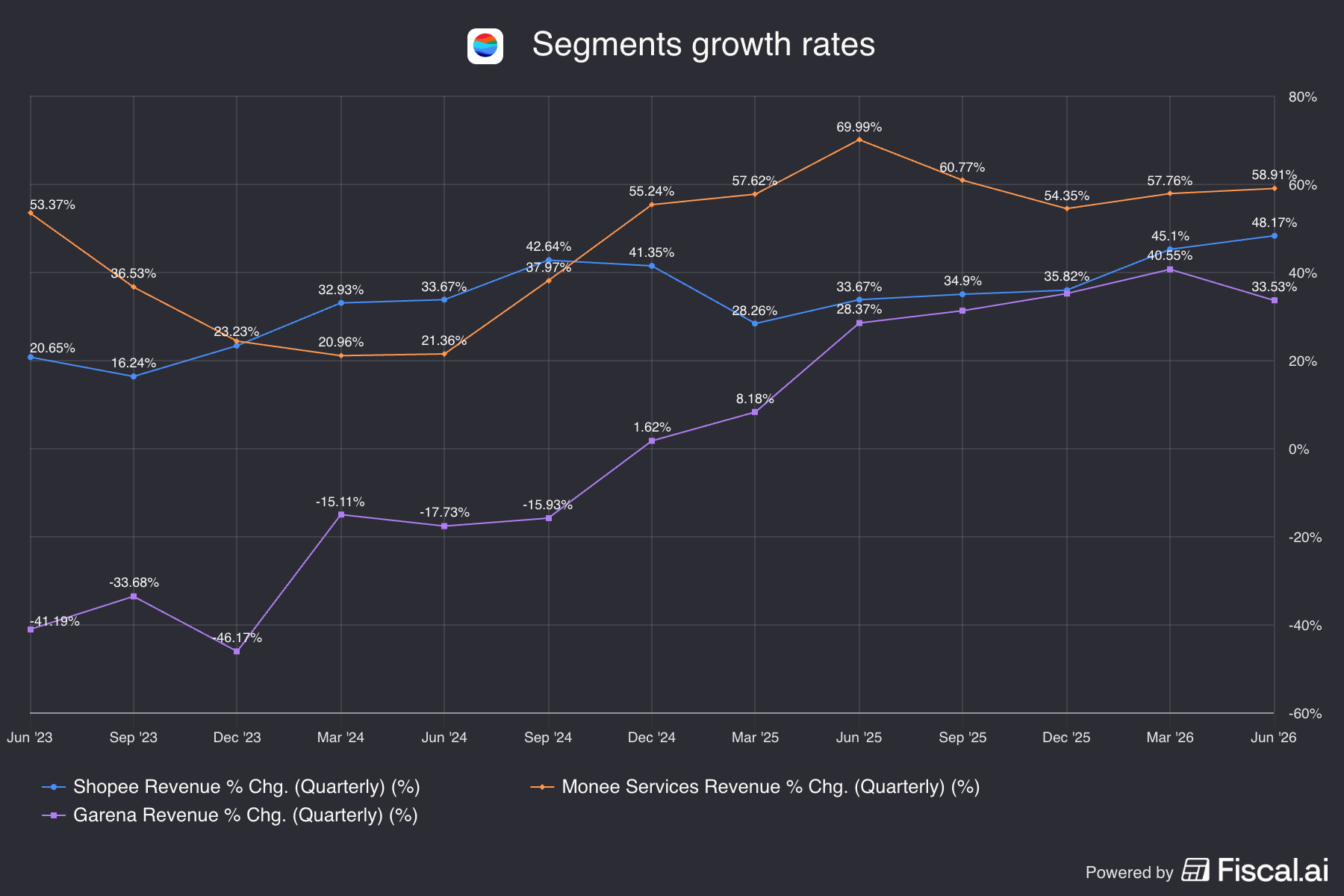
The drivers were Shopee’s revenue growth at 48%, Monee loans book growth at 63%, and Garena’s bookings growth at 15.5%.
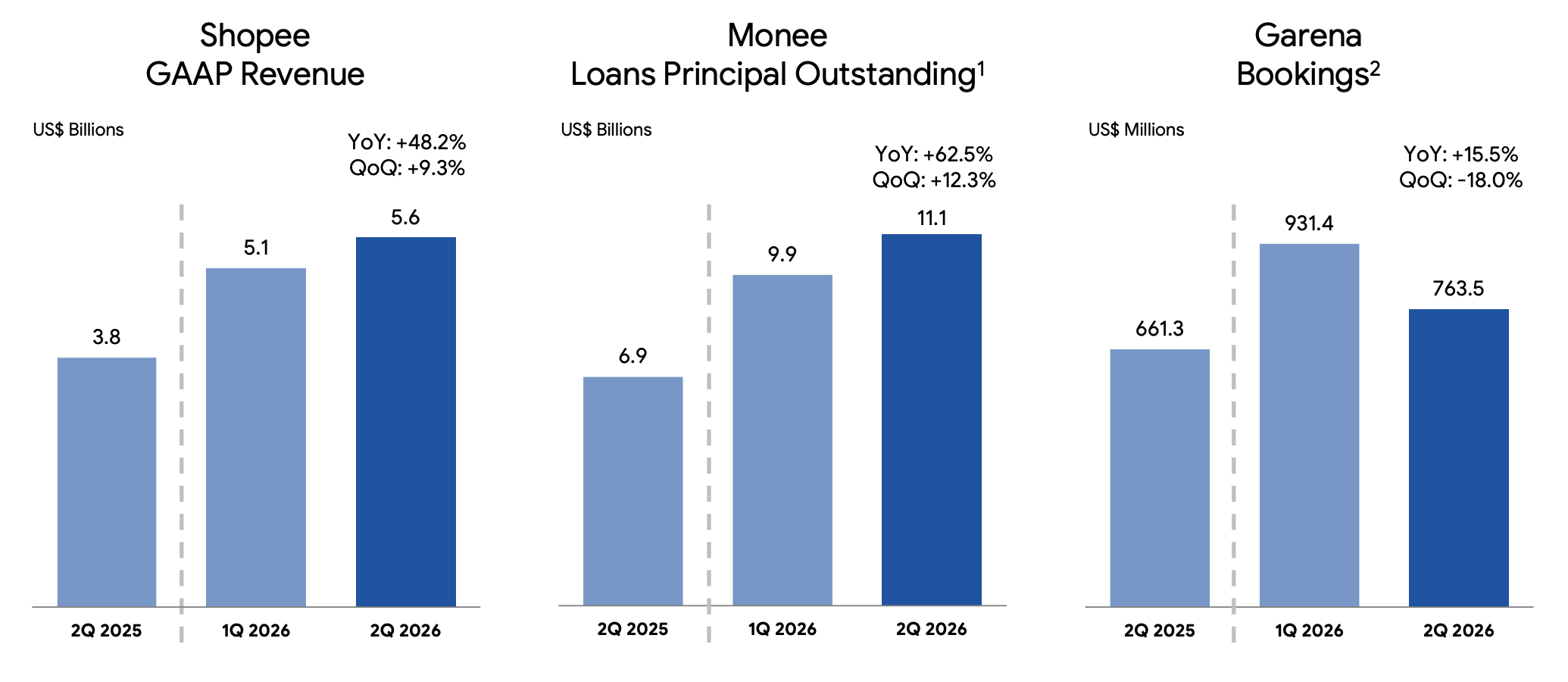
Below, you can see that revenue growth for all three segments has been incredible over the past three years. Shopee accelerated from 20% to 48% this quarter, Monee kept growing at a high-speed lane at 60% for 8 quarters, and Garena has recovered from post covid lows.
But all eyes are on Shopee’s long-term margin. Let’s focus on this before moving to Monee and Garena.
Shopee - Long-term margin: 2-3%
Management's goal is to get Shopee margin to 2-3%. We are at 0.7%. How will they get there?
Cost improvements (SPX and fulfillment cost structure improvements over time)
Better take rate (ads or other forms)
a. Cost improvements
The roadmap has always been reducing costs through volume. Building a logistics network that is cap-light and dynamic. In Q2, the focus of the discussion was on fulfillment. Like Amazon FBA, Shopee shoulders all the logistics and warehousing for merchants in exchange for a fee.
Fulfillment is a double-digit business, and economics are improving
Improvements were driven by
(i) optimizing the cost structures.
(ii) operating leverage as it scales up. More sellers and buyers joining spread more of the cost out.
(iii) integrations between fulfillment and SPX reduced the frictions between how items in the warehouse move across the entire value chain.
Overall, management reiterates the strength of Shopee’s capital-light fulfillment strategy coupled with mid-size warehouses.
We can realize the cost synergies and cost benefits by running both the warehouse and logistics together. All these things help us to build the fulfillment businesses and helping us to gain the advantage of the overall platforms. Again, we run fulfillment business in relatively light CapEx fashions that we do not own the land, we do not own the warehouses. […] We are also experimenting more automation with our fulfillment center recently, which actually reduce our cost to run as well. That is still in the early stage.
b. Take rate
Take rate is a balancing act between
how much reinvestment is required to grow the ecosystem,
price competitiveness compared to other platforms and versus offline pricing.
sellers’ profitability
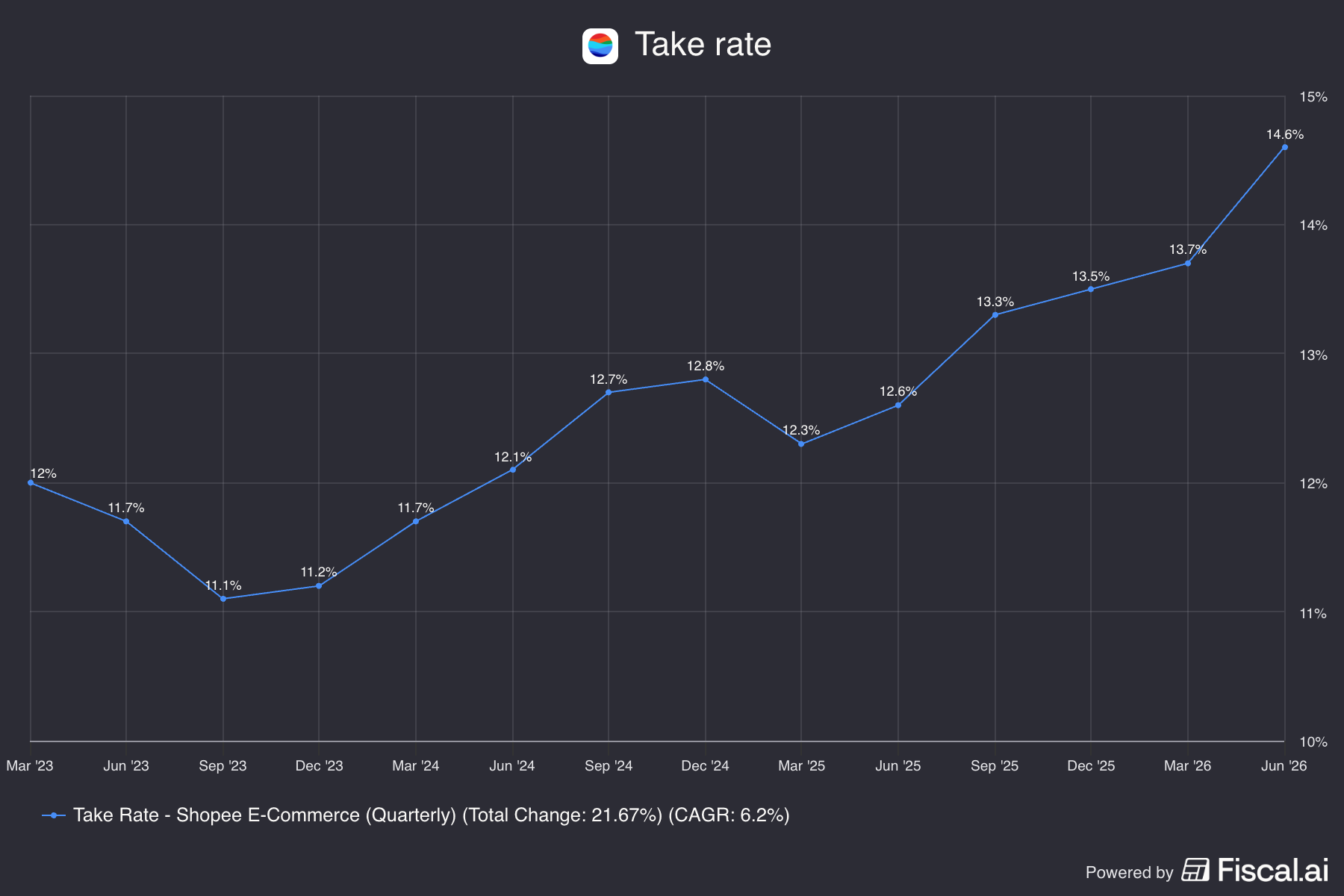
Management see higher take take from commissions and from advertising.
Advertising - a clear gateway to 2-3% margin and beyond.
Ad revenue was up more than 70%, and ad take rate improved by over 90 basis points year-on-year, driven by more Ad-paying sellers, which rose around 45%, and higher average ad spend per seller, which increased more than 15% year-on-year.
The growth rate is on par with Mercado Libre and much higher than Amazon (20%) today, and higher than Amazon in the early days, which was 50%, but for a long period between 2013 and 2020. Today, it’s already 8% of Amazon’s GMV and 10% of its revenue, with a 60% operating margin.
So, Shopee’s ads are only in the second year running (started in 2024) and have a long runway to improve Shopee’s overall profitability.
Advertising is one of my core theses on why Sea will be a big winner in the future. Everything else (logistics, livestream, AI) is all catered to bring more sellers and buyers to the platform so they can use more ads on Shopee. In Q2, these numbers look strong.
Average monthly new active buyers grew more than 35% year-on-year, a significant acceleration from previous quarters.
Average monthly active buyers increased 18% year-on-year, and overall buyer engagement also continued to improve, with purchase frequency increasing by 8% year-on-year.
Other discussions - Market share, VIP, Livestream
Management observed that Shopee is maintaining market share, given its price competitiveness and wide assortment of items.
Competition was also relatively stable in Southeast Asia and Taiwan.
In Brazil, they claimed growth is well above the market growth levels.
Shopee was still very price competitive, a lot stronger than the competitor in the region, even after there is change on the take rate and the free shipping threshold. So we believe that for e-commerce businesses, the fundamental still holds. It is the price competitiveness of our assortment.
Additionally,
It is the completeness of our assortment. It is the fundamental structure of cost to serve, and it is experience of how the buyers can discover the product on our platform. All those things help us to grow faster in the market in Brazil. If you look forward, we still believe that Brazil has a long way to go in term of e-commerce growth. We are hoping to grow in Brazil in a profitable fashion, with the growth rate outpace the market in the coming quarters.
Overall, Shopee management believes it is growing faster than Meli (and perhaps TikTok) in Brazil, even after Meli’s drastic free shipping investment (R19, down from R79)
VIP Members: 15M and contribute 24% of GMV
Q1 2025: >1m
Q2 2025: 2m
Q3 2025: 3.5m
Q4 2025: 7m
I am very excited about the Shopee VIP program. That’s the e-loyalty program. And it is the most effective way to grow GMV, given that Shopee’s monthly active buyers and market share are already >300M, making it much harder to acquire new Shopee members now. But enticing existing members to spend more and more frequently improves the quality and predictability of Shopee’s revenue. Q1 showed that each conversion increases their spend per user by 30-40%.
Members are still ~4% of total monthly active buyers (est. 300M in 2023) but already contributed 24% of GMV in Asia in the quarter. Average monthly retention remains strong at around 80%, and members continue to show higher engagement, spending meaningfully more after subscribing.
Brazil went live in April and has already surpassed 1M.
Live stream - bringing in traffic (35% of physical goods)
Live streaming and partnerships with YouTube and Meta (Facebook, Instagram) are Shopee’s counter to TikTok. It’s been going on for a year, and Q2’26 shows it’s working. Traffic from outside of Shopee is ringing in.
Orders from live streaming and short-form video grew more than 50% year-on-year, outpacing the 28% total GMV growth and accounting for more than 35% of physical goods orders in Southeast Asia. Unit economics also improved sequentially as Shopee further optimized the marketing spend.
Shopee affiliate orders generated by these creators on Facebook increased by more than 85% quarter-on-quarter, with Facebook Reels proving to be a very popular channel to drive purchases. We have now extended our Instagram collaboration to all eight of our core markets, and we are seeing promising early results from Indonesia, the first market where we launched the partnership
Monee - Brazil expansion and credit risk
Revenue grew 59% to $1.4B and Adj. EBITDA grew 13% to $288m, driven by growth in the
Loan book at 61% to $11B,
Active credit users >40m, +34%YoY
There is a growth gap between revenue and adj. EBITDA. Management attributed this to loan mix, promotional loans to new borrowers, and investment in Brazil.
Monee has been a solid source of profitability and growth for the last 2-3 years. However, like Pago, we can see Monee is reinvesting aggressively to acquire new users in off-Shopee SPL lending (20% of SPL today), but that’s naturally lower-margin than on-Shopee.
Monee is also expanding rapidly in Brazil due to the vast potential. Pago has been operating for over 20 years and continues to post 40-50% revenue growth. Q2 saw a 68-75% growth in assets under management and the credit portfolio.
Excerpt from my Meli’s Q2 review
Hence, Monee launched the ShopeePay app in Brazil, similar to Pago and NU Bank.
Going forward, Monee will no longer be in a supporting role to Shopee but will drive much of future growth and profitability. For now, we can expect Monee’s Adj.EBITDA to grow more slowly and leverage its clear data advantage from Shopee.
With our e-commerce user base, our e-commerce data, and also with our better credit scoring algorithm that's proven in Asia already, but of course, we customize for Brazilian flavor. We are able to broaden our product in Brazil over time. If you compare what we offer and what the other player offer, there are many low-hanging fruits that we believe that we can capture just by doing the right product structures, inputting the right data in our platforms to better credit scoring users, and just also with the license we applied, which is kind of as good as the others already in the market.
Importantly, Monee seems to have risks under control, thus far.
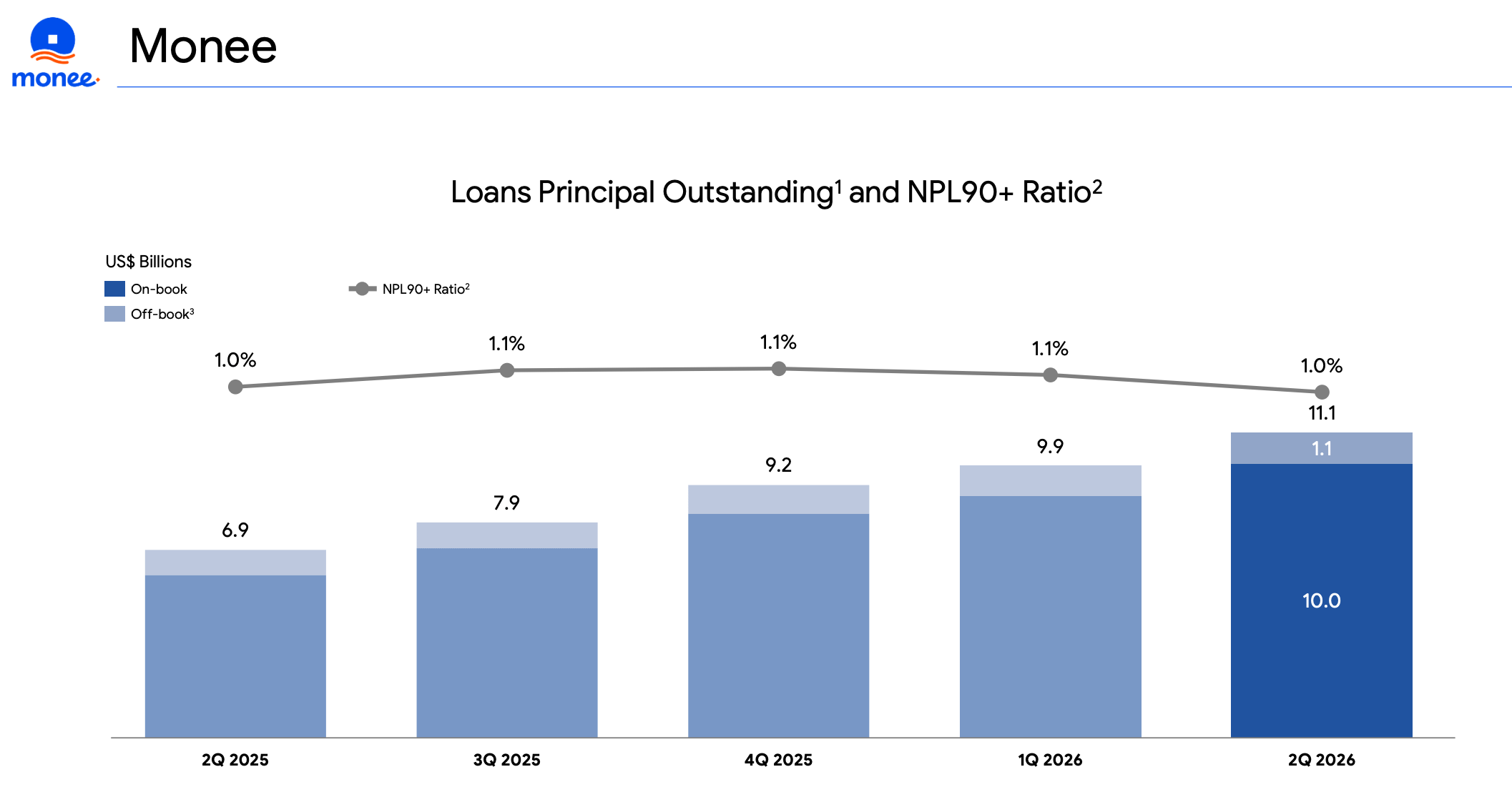
While the loan book grew by 61%, the NPL ratio of 90+ contracted to 1%. Management sees no correlation between loan book growth and the increase in credit risk. My only pickle is that they haven’t shared much about the composition of the loans, the size of the loans, the country, or the NPL of 15-90 days, which can indicate how credit risk is evolving early on. With the 90+ day, it could already be written off and may not show on the 90+ day metric.
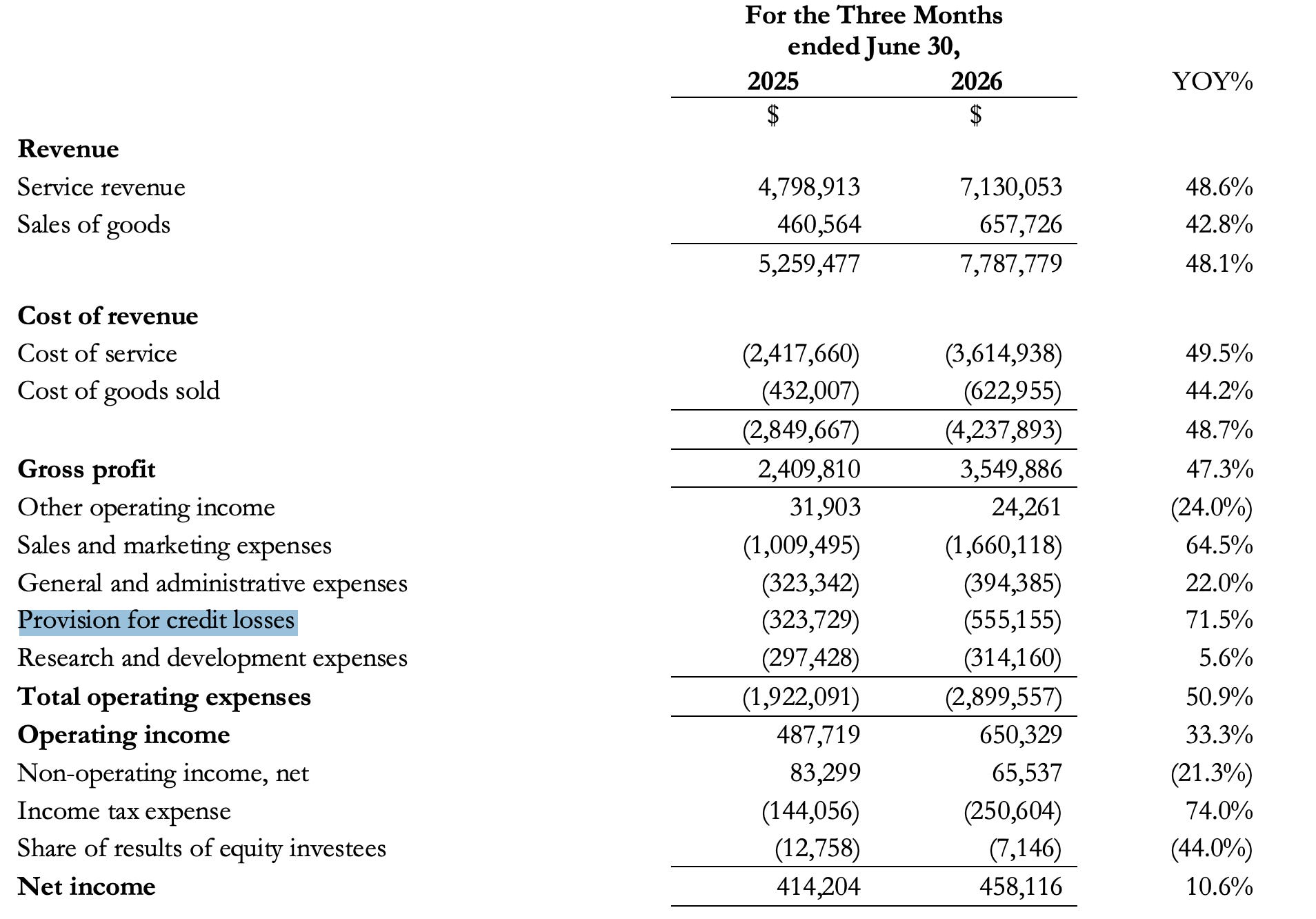
One way I see it is that the provisions going up by 71.5% is worth watching. Not a red flag now, but I’ll be monitoring this.
Finally Garena,
Garena - a steady quarter
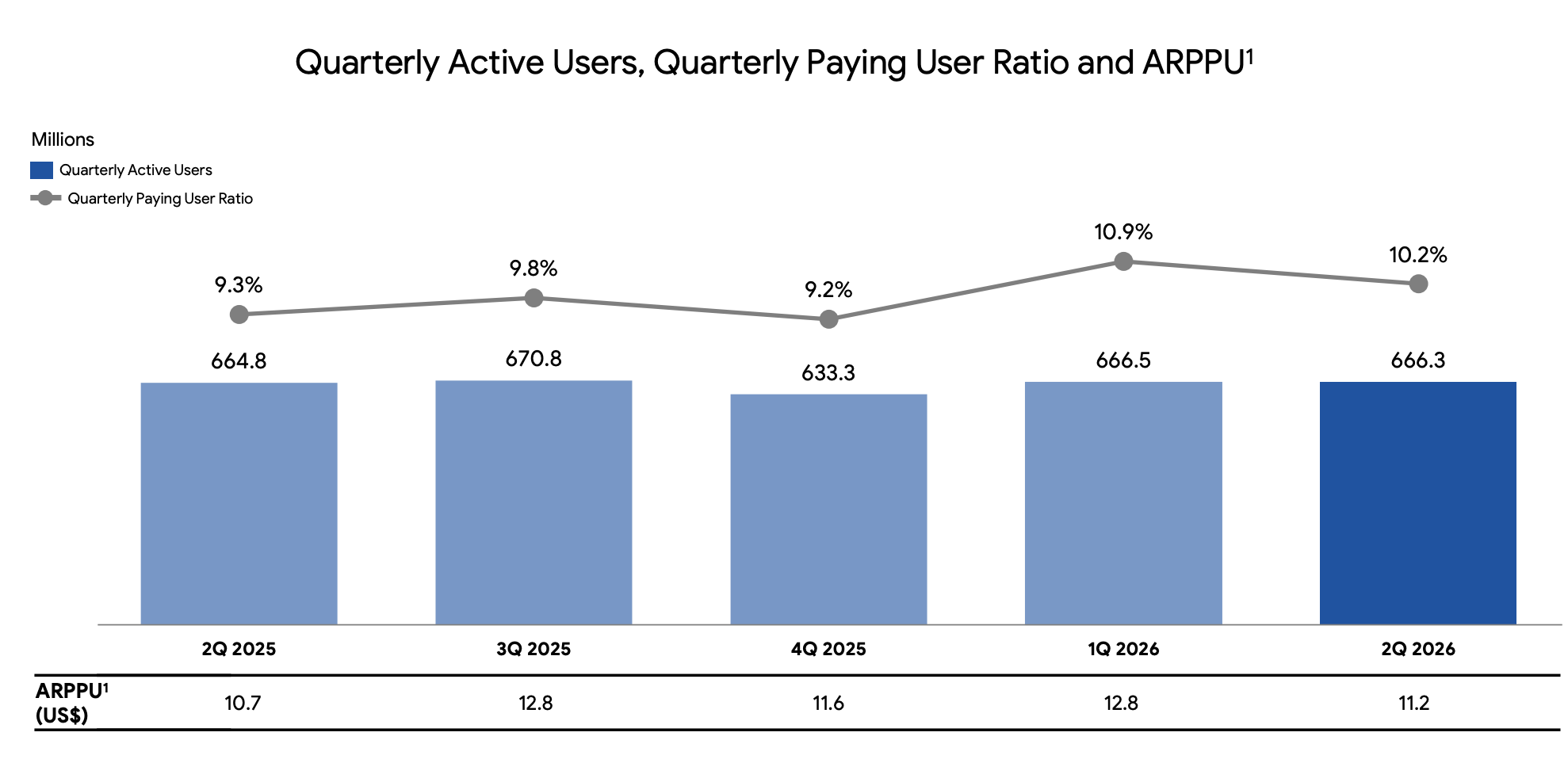
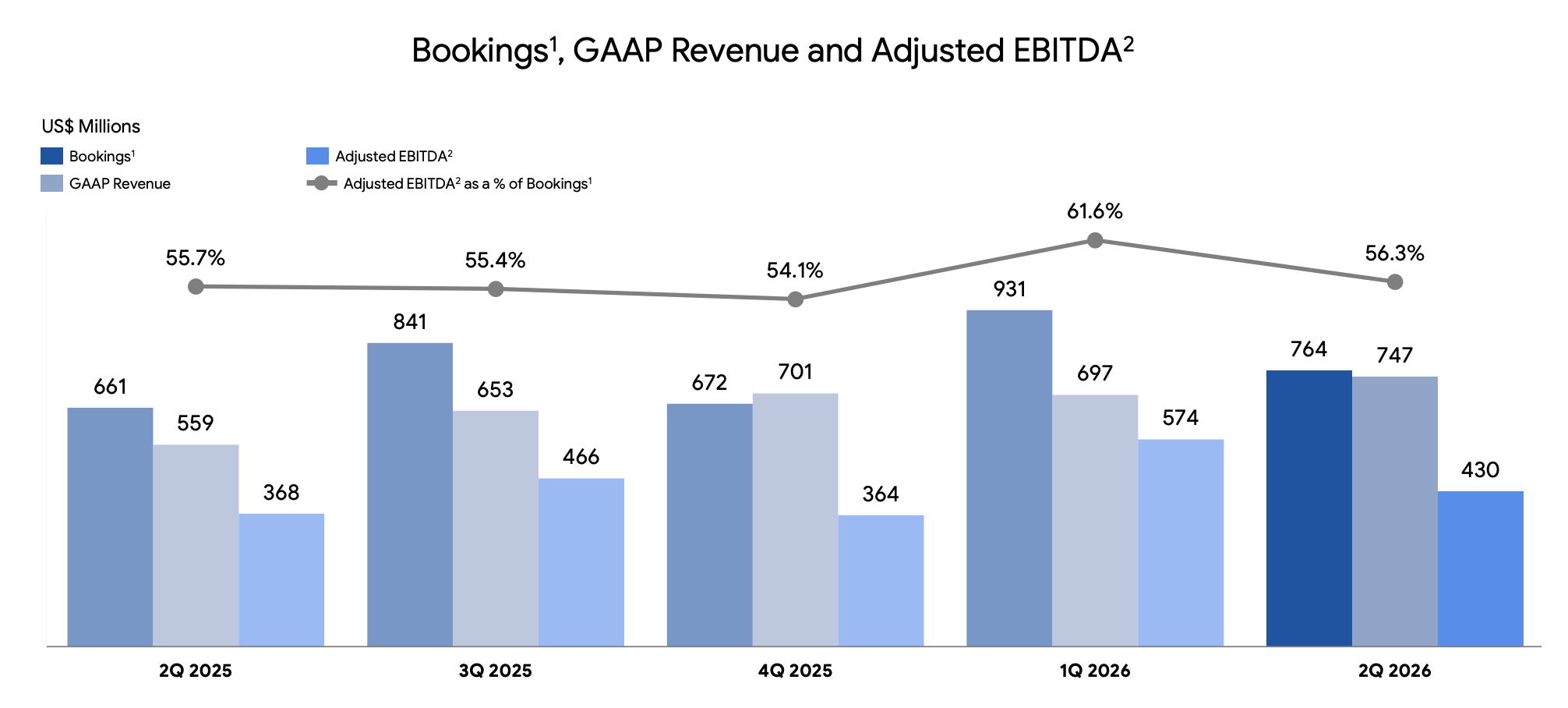
Nothing special in Q2, with stable 666M quarterly active users and 66M paying users. I’ll post two slides here for our future reference.
Free Fire is 8.5 years old and still strong, with partnerships and event adaptations. It’s still to prove if Garena and develope and publish another block buster game.
Conclusion
Sea is executing expertly, dominating a very fragmented region in Southeast Asia, and now growing profitably in Brazil. Lots of investments required but also a lot of potential. I am happy management is playing the long game.
I am most impressed by the sustained VIP growth and Livestream's contribution to traffic and order conversion, which proves buyers and users are more engaged than ever and suggests Shopee might have cracked the formula to play offense against TikTok Shop.
With ~4B Adj. EBITDA and an $80B market cap (~75B EV), 20% growth over the next 5 years, and management has started buying back shares ($90/share), Sea remains my largest position and is always a good place to add more shares on dips.
A gift for reading the whole analysis and not falling asleep!